




Athens Greece - Travel information, Athens hotels, villas, tours, restaurants, beaches, archaeological sites, nightlife
The capital of Greece has recently undergone a major facelift thanks to the 2004 Olympics and has become more visitor-friendly than ever. Not only does it offer several of the world's most significant archaeological sites, structures and museums, it now has a wide selection of restaurants, ranging from basic indigenous food to fine gourmet dining, and a similarly wide selection of shops and goods. Whether visiting the incomparable Acropolis or the new subway system, you will find that Athens rewards your time before setting off for the islands, each of which has been chosen by TrueGreece for offering something distinctive.
Athens: A Journey in Time
Athens! There may be more grandiose cities, there are certainly larger cities, there may even be older cities. But is there any city in the world, to award the highest accolade of our day, more resonant than Athens? And this is not just a Western-centric perception. As you walk around the streets of Athens today, you will encounter visitors from all over the world who have come not only to pay their respects but also to share the “vibrations” of this extraordinary city.
Now it is true, most people come to Athens intending to pay their respects to the Athens of the Golden Age of ancient Greece-Athens of the Classical Age. What they discover is what you will discover: that there is far more to Athens, that this is a multidimensional city. To begin with, the history of Athens commences far earlier than the Classical Age (usually assigned to about 490-320 BC), even though mostly specialists and students will seek out the sparse remains of these earlier phases: the Neolithic period (approximately 6500-3000 BC) and the Mycenaean period (1600-1200 BC). Scholars once thought of the centuries between about 1200 and 800 BC as a “dark age” for Greece and Athens, but now recognize this as a time of retrenchment and reorientation, during which Athens moved to the fore among the evolving city-states. Between 800-500 BC, Athens emerged as an innovator in sculpture, ceramics, and architecture but perhaps more importantly, in political institutions, culminating in a form of democracy.
And of course, most recently, in a tremendous outburst of energy Athens readied itself for the 2004 Olympics-renovating many of its public and private structures, landscaping public spaces, setting aside pedestrian streets, and completing an expanded subway system that is both an engineering and an aesthetic marvel (even if you don’t have occasion to ride it, at least go into the station at Syntagma Square to admire a small collection of ancient ruins).
Athens Highlights:
- High Archaeological value
- High Cultural Value
- Excellent Cuisine
Athens History
When the Greek city-states found themselves threatened by the Persian Empire, it was Athens that took the lead in resisting, first at the battle of Marathon in 490 BC, and then at Salamis in 480 BC. But before Salamis, the Persians had in fact seized and sacked Athens, so it was in the decades after that incident that the Athenians set about building the city that we today know as “classical” Athens. The Acropolis had always been the focal point of Athenian religious life, and under the leadership of Pericles from 458-429 BC the Athenians erected the Parthenon, the great temple visitors admire to this day. Below the Acropolis hill lies the Theater of Dionysus: this is essentially the theater where the plays of Arechylus, Sophocles, Euripides, Aristophanes, and others were performed.
Classical Athens and the Golden Age
When the Greek city-states found themselves threatened by the Persian Empire, it was Athens that took the lead in resisting, first at the battle of Marathon (490 BC), and then at Salamis (480 BC). But before Salamis, the Persians had in fact seized and sacked Athens, so now the Athenians set about building the city that we today know as “classical” Athens. The Acropolis (“peak of the city”) had always been the focal point of Athenian religious life, and now, under the leadership of Pericles (458-429 BC), the Athenians erected the great temple to their guiding spirit, the goddess Athena-the Parthenon (447-434 BC). Visitors are usually surprised to discover that there are still a fair number of sculptures on the Parthenon; some of the originals are in the Acropolis museum, but this does not satisfy Greeks and many others who feel that the so-called Elgin Marbles, carried off to England in 1801, should be returned to Athens. In fact, the new Acropolis museum has left an entire floor free to house the Elgin Marbles!
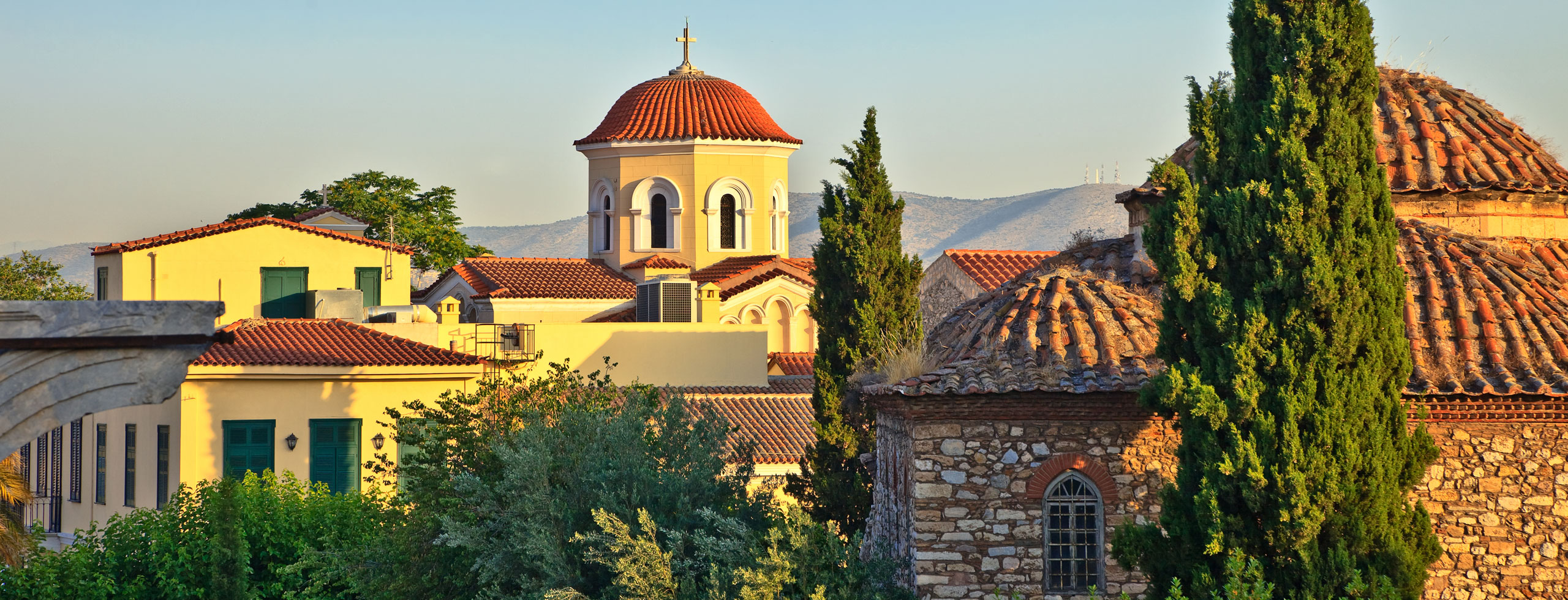
A visit to the Acropolis, of course, will involve viewing the other great structures there-the great entryway known as the Propylaia, the Erechtheion (with the 6 maidens known as the Caryatids, supporting the roof; 4 of the originals are in the Acropolis Museum), and the temple of Athena Nike. But while on the Acropolis, many will want to take this occasion to view some of the structures around its base. Standing with the Erechtheion at your back, you look down across the ancient Agora (“market place”), at the center of ancient Athens civic and social life; the long colonnaded, surprisingly intact building along one side is the Stoa of Attalus, a complete reconstruction after World War II (with the aid of Rockefeller money). At the far opposite corner, another surprisingly intact temple is the ”Theseion”; one of the best preserved ancient buildings in Greece (dated to about 450 BC) thanks to the fact that it was long used as a Christian church!
Walking to the other side of the Acropolis you look down on an open-air amphitheater, the Odeion of Herodes Atticus. Named after a wealthy Roman who admired Greek civilization, this theater continues to be used for all kinds of musical and theatrical performances (at least one of which you may want to attend during your stay in Athens). And then off to the left as you look down is the Theater of Dionysos; although rebuilt over several centuries, this is essentially the theater where the great dramas of ancient Athens were performed-the plays of Aeschylus, Sophocles, Euripides, Aristophanes, and others. While still on the Acropolis, you should also turn and look across over the great entryway to the hillside facing the Acropolis-this is the Areopagus, where the ruling council of ancient Athens met (and which the Apostle Paul addressed on his first mission to Greece).
There are numerous other structures and sites around Athens associated with the Classical Age that some may wish to seek out. In particular, there is what little remains of the Temple of Olympian Zeus. It took some 700 years before it was completed and stood as the largest temple in Greece. And even those who are not well informed about ancient Greece find it quite moving to visit Kerameikos, the cemetery of ancient Athens with its sculptured gravestones.
Athens through the Centuries
The “Golden Age” of Athens became tarnished after its long Peloponnesian War with Sparta (431-404 BC) although it continued to be the center of art and philosophy-the latter embodied by Socrates, Plato and Aristotle. It faded still further after the death of Alexander the Great in 323 BC, who with his fellow Macedonians had conquered the city along with most of Greece by 338 BC. It should come as no surprise, then, to hear that the Romans took over Athens along with all of Greece by 146 BC; if we had to single out only one of the several remains of this era that visitors might want to seek out, it would be the Tower of the Winds at the Roman Forum.
As the Romans themselves declined in power, Athens was subjected to raids of the so-called Barbarian tribes from northern Europe. After Rome lost control of Greece to the Eastern Empire based in Constantinople (AD 395)-what is known as the Byzantine Empire-Athens became little more than a backwater town. Little survives in Athens from the next 800 years except several fine old Byzantine churches (recognizable today because they sit below the current street levels!). Then in the 13th century, after Constantinople itself fell to alleged “Crusaders,” Athens like much of Greece found itself ruled by a succession of Western Europeans (this was the period of a Duke of Athens, perhaps familiar to you from Shakespeare’s Midsummer’s Night Dream). This phase ended when the Ottoman Turks took over the Byzantine Empire in 1453, but again, Athens did not play an especially important role in the Turks’ empire. In fact, the Turks had so little regard for the glories of ancient Greece that they used the Parthenon as a storehouse for ammunition; when Venetians were trying to drive the Turks out of Athens and bombarded the Acropolis, they hit the arsenal and left the Parthenon in the ruined state that we see today.
Athens in the 19th Century
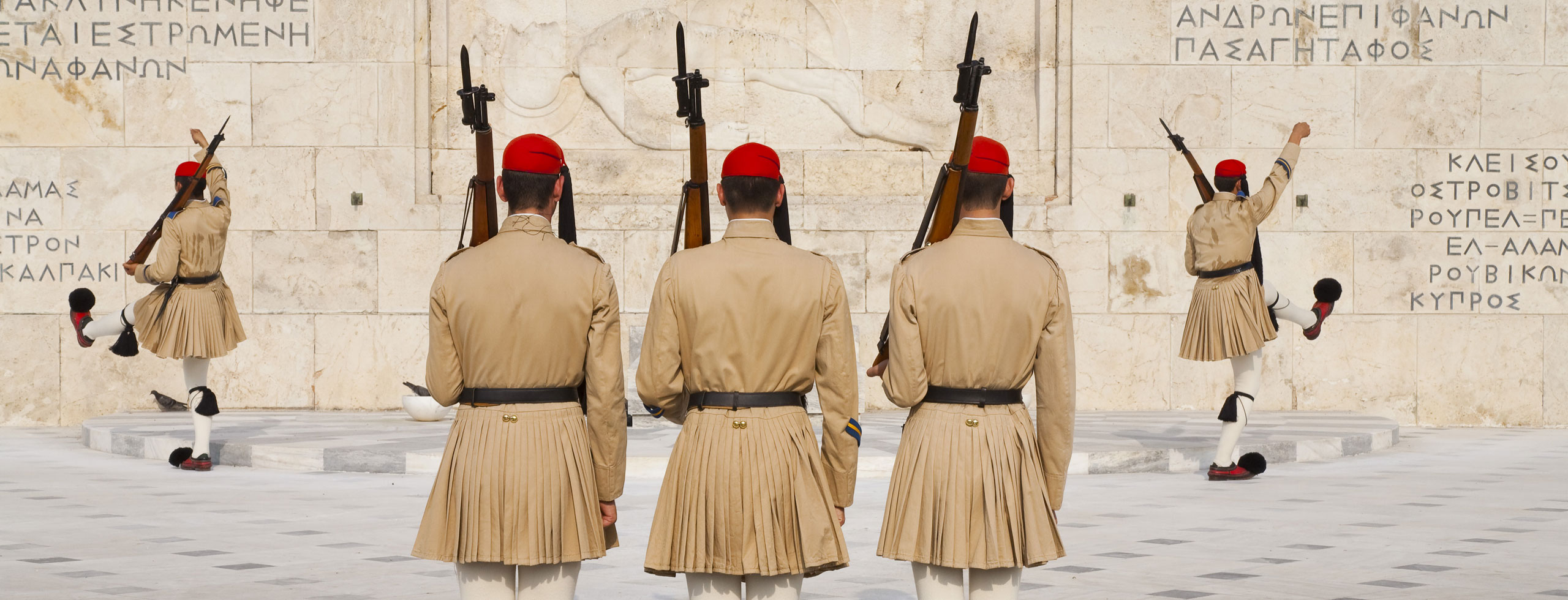
By the time Greeks launched their revolution against the Turks in 1821, Athens had been under Turkish rule for over 350 years and had become a truly backwater town. In fact, after the Greeks won their independence in 1829, they chose Nafplion as their capital. Only in 1834 was the capital of modern Greece moved to Athens, and it was during the remaining decades of the 1800s that the city now visited by so many was laid out and built up. All the major boulevards and avenues; the major squares such as Syntagma (“Constitution”) and Omonia (“Concord”); the great public buildings such as the old Royal Palace that is now the seat of Greece’s Parliament and where the elite unit known as the Evzones guard the Memorial to the Unknown Soldier (the uniforms, based on those worn by soldiers in the early 19th-century revolution, may amuse you but realize that Greeks regard this as a solemn site); the University and other educational and cultural institutions; the many turn-of-the-century beaux arts mansions-these are all the heritage of the 19th century (one of these mansions, just down from Syntagma Square and now the site of a Numismatic Museum, was built by Heinrich Schliemann, the legendary excavator of Troy and Mycenae).
Modern Athens
Athens continued to expand its structures and population during the first decades of the 20th century as Greeks were forced out of Turkey in 1923 and villagers from all over Greece flocked to the capital for jobs and community. Then Athens, like the rest of Greece, had to endure the harsh occupation (1941-44) by the Germans during World War II, and no sooner had that ended than it became a battleground for the conflict that developed into the civil war that racked Greece until 1949. When that ended with the victory of the conservatives/monarchists, Athens started down its new road to prosperity, in part propelled by the growing influx of international tourists. This was temporarily sidetracked under the dictatorship under a group of Army officers (1967-74), but with the return to a democratic government, Athens began the phase of construction and expansion that has made it the home of at least a quarter of Greece’s total population (and at least one half when several contiguous suburbs and its adjacent city of Piraeus are included).
Those who prefer to understand and appreciate a country and its people by walking their cities’ streets will find no end of fascinating diversions in Athens. Many of the modern city’s major shops and facilities are located on the Syntagma and Omonia squares and the avenues that link them. But most visitors head straight for the Plaka, the old neighborhood at the base of the Acropolis and now the location of many of the favorite restaurants and gift shops. Directly adjacent to it is the Monastiraki district, home of a perpetual flea market and more restaurants. For those drawn to such things, the great Central Market-with its open-air stalls selling meat and fruits and cheeses-is located on the Athinas Avenue that links Monastiraki Square with Omonia Square. Others may prefer to head for the Kolonaki district, center of the upscale shops, cafes, and apartments of chic Athenians. But whatever your preference in neighborhoods, the stores of Athens offer a wide selection of goods, from the most obvious souvenirs to fine jewelry.
Route 2: Excursions Around Athens
Those with still more time and an inclination to explore may use Athens as the base for day-long excursions to a number of sites. Marathon, site of the famous battle (and starting point of the first marathon!) is perhaps the best known destination. Equally popular is the small Temple of Poseidon at Cape Sounion, usually visited at the time of sunset (and thereby usually jammed with tourists!). The 11th-century Byzantine Church at Daphni rewards those who may never have known how spectacular mosaics can be, while the 11th-century monastery at Kaisariani rewards those who may have never understood how restorative a cloister can be. Two other excursions offer quite contrasting experiences. North of Athens are a number of increasingly upscale suburbs, the oldest and most stylish being Kifissia. Since the time of the Romans, its elevation and pine trees have been providing a welcome retreat from the summer heat of Athens; today it is the home of smart shops and fine restaurants. Then south of Athens are the stylish seaside areas of Glyfada and Vouliagmeni, as well as the age-old port city, Piraeus; for most foreigners, this is merely the jumping off point for ferries and cruise ships to the islands of Greece. But these are another story.
Route 3: Shopping Guide
Whatever you preference in neighbourhoods, the stores of Athens offer a wide selection of goods, from the most obvious souvenirs-any store in Plaka or Monastiraki will provide an ample choice-to fine jewelry and designer clothing, mostly in the Kolonaki area. In Kolonaki, window (or real) shopping on Skoufa, Tsakalof, Patriarchou Ioakim, Voukourestiou and Valaoritou streets will surely be a pleasant experience, if not for any other reason simply to see the faces of modern Greeks and their shopping habits. Attica, the centrally-located mall that opened in 2005 on Panepistimiou and Voukourestiou streets will also prove a great option for some fashionable shopping, as will Ermou street by Syntagma Square. But why not also try shopping for something different, like tinted print of Old Athens or a high-quality reproduction of a favorite museum work.
Another good choice for fun shopping-although at some distance from the center of Athens- is visiting “The Mall” and the “Golden Hall”. Located in Maroussi, both venues combine many different choices for fun, food and fashion, marking a new era in shopping and leisure choices for the Athenian public. Kifissia and Glyfada, northern and southern suburbs of Athens respectively, also provide a wonderful variety of stores.
Museums & Activities
Athens is host to a number of marvellous museums that are welcoming thousands of visitors each year!
- National Archaeological Museum, Patission 44, Athens, tel.: 210 82 17 724. Unless just plain phobic about museums, everyone should make a visit, however brief, to the National Archaeological Museum, the world’s greatest collection of the masterworks of ancient Greece: even an hour’s stroll through its main galleries is the equivalent of an introductory course in Greek art.
- The Benaki Museum, Koumbari str 1 & Vassilissis. Sofias av., Athens tel.: 210 36 71 000. The Benaki Museum not only hosts an admirable collection of works from the Neolithic Age to modern Greece, but is also home to a fabulous restaurant.
- The Goulandris Cycladic Museum, Neofytou Douka 4, Kolonaki, tel.: 210 72 28 321. Home of the Cycladic Collection (3200-2000 BC), The Ancient Greek Art Collection (2000 B.C-400 A.D) and the wing of the magnificent Stathatos House a neo-classical creation by Ernst Ziller.
- The Byzantine Museum, Vassilissis Sofias av. 22, Athens, tel.: 210 72 11 027. The exhibits include 3500 icons, 4000 religious and secular artifacts and ornaments and a large collection of documents from the early Christian years to the Post-Byzantine years.
- The Greek Folk Art Museum, Kydathinaion 17, Plaka, tel.: 210 32 13 018. The Conservation Laboratory for museum objects is staffed by specialists in the conservation of fabrics and different materials, especially wood and metal. The responsibilities of the Laboratory include all work and activities connected with the preventive and active conservation, restoration and protection of the Museum collections, and also the documentation and publication of the conservation work.
- The Jewish Museum, Nikis 39, Athens, tel.: 210 32 25 582. The permanent exhibition illustrates subject areas such as the Synagogue and religious artifacts, the Jewish holidays, traditional costumes, the Holocaust, the cycle of life and the history of Greek Jews. Particular attention is paid to the Museum’s educational role, especially with regard to intercultural education and programs for children and young people.
- Lalaounis Jewelry Museum, Kalisperi 12, Acropolis, tel.: +30 210-9221044. The permanent exhibition displays 3000 pieces of jewelry and micro-sculpture from 45 collections designed by Lalaounis in the period 1940-1992. Actual jewelry craftsmen may be seen at work in the Museum’s Model Workshop. There is a cafe and restaurant on the ground floor, and a roof garden with a view to the South side of the Parthenon.
 View Athens Map