



Paros Island Greece - Travel information, Paros hotels, villas, tours, restaurants, beaches, archaeological sites, nightlife
As in ancient times, Paros island is still covered with softly contoured hills and is full of picturesque villages and remains and structures from across the centuries that reflect its rich history. To the Greeks and those in the know each island is distinctive, even unique, but if there is one that seems to combine many of the elements that attract visitors to these islands it might be Paros. This impression begins the moment you sail into the harbour of the main town, and will continue as you move around the island and experience its natural environment and village life. By escaping to Paros you will realize that you have found your ideal typical Greek island.
To Greeks – and those “in the know” – each Greek island is distinctive, even unique, but if there is one that seems to combine many of the elements that attract visitors to the Greek Islands it might be Paros. This impression begins the moment you sail into the harbor of its main town, Parikia, to be greeted by the white “cubic” buildings typical of the Cyclades islands. It will continue as you move around the island to experience its softly contoured hills, picturesque villages, natural environment, and the village life of the locals. It will be confirmed when you begin to explore the island with its archaeological and historical remains that testify to Greece’s age-old culture. And it will be satisfied when you settle on one of the lovely beaches or into a fine restaurant. Then you, too, will realize that, in Paros, you have found your ideal typical Greek island.
The Panagia Ekatontapyliani Church
The “must-see” site of Paros is the island’s cathedral, the Panagia Ekatontapyliani –literally “Our Lady of the Hundred Doors.” Scholars believe this is corrupted Greek for “below the town” but it is popularly explained as referring to the many entrances to the various structures that make up the cathedral complex (popular lore also claims that when the 100th door is found, then Constantinople will return to Greek possession!). Built on the site of a late Roman structure, the original church is said to have been sponsored by the first Christian emperor of Rome, Constantine, in honor of his mother, St. Helena, who stopped here while on her way to the Holy Land in quest of the True Cross. This would have been about 320 AD, while the smaller Agios Nikolaos church that abuts the left side of the apse dates from the 6th century. Over the centuries, earthquakes, expansions and renovations drastically changed the early church, but in the 20th century a Greek archaeologist restored it to what he regarded as the structure resembling its early Byzantine appearance. Whatever the dates and details, the Panagia Ekatontapyliani is one of the most sacred locales of Byzantine Christianity and moves all who enter its precincts.
Leisure on Paros
Especially in recent decades, Paros has become a full-fledged participant in the world of international tourism, with a full spectrum of accommodations and eating places to satisfy visitors of every taste and budget. The widest choice is in Parikia, but if you find the first “row” along the harbor too touristy, simply head deeper into the town. And now towns like Naoussa, Marpissa and Drios offer a selection of accommodations and restaurants. Paros offers no end of beaches: On the west coast are Kolimbithres, Monastiri, Langeri, Santa Maria, Ambelas, Glyfades, and Tsoukalia. On the east coast are Molos, Chrissi Akti, Drios, Loloantonis and Faranga. It should be said that many of these beaches are inaccessible except by walking up to an hour or so, and several are extremely windy so appeal mostly to windsurfers. But you should never lack for a fine day at the beach on Paros.
Other excursions on Paros include a visit to the Marathi Quarries, where the famous marble came from; determined types can explore the subterranean tunnels (bring a flashlight –and be careful: they are slippery!). Appealing to less adventurous souls is a visit to the Valley of Petaloudes –or “valley of the butterflies.” In fact, they are migratory tiger moths, and they are at their greatest number in June. One way to get to this area is by mule or donkey out of Parikia; you can get fairly close by bus but face a walk of 1 ½ miles (2.5 KM). Having come this far, women may want to visit the nearby Convent of Christos Dhassous. A more ambitious excursion is to the islet of Antiparos, only a half mile off the west coast (boats leave Parikia and Pounta fairly regularly in the tourist season). The main attraction here is a cave with spectacular stalactites. Lord Byron visited this cave, and in 1673 a French aristocrat celebrated Christmas mass here with 500 in attendance. All in all, then, Paros lives up to its reputation: the Greek island with something for everyone.
Paros Highlights:
- Excellent Beaches
- Excellent Water Sport Facilities
- Rich Nightlife
- High Natural Beauty
Paros History
Paros, according to mythology was named after the Arcadian hero, Parios, who took over the island from the Ionians. In Ancient times Paros was famous for its quality marble and infamous for siding with the Persians against Athens in 490 BC. After Constantinople fell to the Crusaders in 1204, Paros was taken over by the Venetians who ruled until the island fell to the Ottoman Turks in 1537. Several castles and forts from this era are still preserved in good condition and are well worth a visit.
Paros Through the Centuries
Paros, according to mythology, was named after the Arcadian hero, Parios, who c. 1000 BC took over the island from the Ionians, who had in turn taken it c. 1100 BC from the Cretan-Minoans, but it is claimed that Paros has been hosting humans for well over 5,000 years. One site in particular, Koukounaries, has yielded remains going back to that earliest time. Then about 800 BC it began to be colonized by Greeks from Asia Minor; perhaps that explains why, when the Persians set off to invade the Greek mainland in 490 BC, the Parians actually supplied a ship for the Persians. They paid for this misstep after the Athenians defeated the Persians in 480 BC by becoming a colony of Athens. And the mainland Greeks got something more than a small island: they got control of the quarries that produced some of the finest marble in the ancient world. Prized for its translucent quality, it was used, for example, by Praxiteles for his famous statue of Hermes and also by the unknown sculptor of the Venus de Milo. After the end of the classical age, Paros shared the fate of most of the Aegean islands, first coming under the rule of the Greek Ptolemies based in Egypt, then the Romans, and then (in 395 AD) the Byzantine Empire based in Constantinople.
On Paros itself there are several remains from these many centuries, two of which will engage even those who arrive with little knowledge of Greek history. One is the so-called Parian Marble, a slab of marble discovered by an Englishman in the early 1600s; as a result, only a fragment is to be seen in the Archaeological Museum in Parikia; the largest section was carried off to in Oxford’s Ashmolean Museum. This is a unique document from the ancient Greek world, for it contains a long inscription that chronicles the history of Greece from its legendary king (c.1580 BC) to 264 BC (although the fragment in Paros has only the later centuries). While you are paying your respects to this quite astounding artifact, you should look around this small museum and at least gaze at the monument to Archilochus (?675-635 BC); one of the finest of all early poets, he happens also to sound like one of the most modern in his mixture of blunt realism and ironic skepticism.
After Constantinople fell to the Crusaders in 1204, Paros was taken over by the Venetians who ruled until the island fell to the Ottoman Turks in 1537. In practice, though, the Turks allowed various Western Europeans – mostly Venetians – to administer Paros so long as they collected the taxes. Several castles or forts from this era are still to be seen, the best preserved being the Castro on the hill at the edge of the sea at the far end of the harbor of Parikia (most of this Castro was made of marble elements from an ancient temple and theater used in this castle). During the following centuries, both the Greek Orthodox and Roman Catholic communities were allowed to build their churches and operate their institutions, hence monasteries and churches from this era dot the land.
Paros was taken into the new Greek nation after the latter was formed in the 1830s and once again the island stepped back into the chorus of history. Its inhabitants lived by fishing, producing olive oil, and growing grain, grapes, and potatoes, but the marble quarries have long since ceased being worked (they did however provide the marble for Napoleon’s grand tomb in Paris’s Hotel des Invalides). Paros remained a relatively poor island through World War II and did not even participate in the first wave of tourism that swept through the Aegean in the 1960s. It was the 1980s before Paros began to be adopted, first by the backpackers seeking a cheaper alternative to the more popular destinations.
Parikia, Paros’ capital city, has outgrown its village roots but remains one of the most beautiful locales on Paros. You have a fine view of the village and the cosmopolitan waterfront when you arrive at Paros with a ferry boat, but the best comes when you start discovering the small town on foot. The setting is typical of a Cycladic island: narrow streets, white-washed houses, hundreds of pots with colorful flowers, and visitors and locals blending in perfectly with the activities of everyday life: dining, shopping, or simply wandering around the beautiful streets. Parikia, with its modern shops, bars, and tavernas, has become quite a cosmopolitan village but also has some parts that will take you back in time. One such place is the old quarter of the town with the 13th century Venetian castle, built with ancient material –claimed to be from a temple of Demeter present on the island in ancient times.
Today Parikia hosts some of the most beautiful and important old churches of the island. Those are Agios Konstantinos, a church of exceptional architecture; the Venetian Church of Christ; and the churches of Agia Ekaterini, Agia Anna, Evangelismos, and Agia Marina. They are all beautiful but definitely the most impressive one and famous all over the Greek Orthodox world is Panagia Ekatontapyliani. It is a cruciform domed basilica and unites three pre-existing paleochristian churches – Agios Nikolaos is the largest one with unique carved iconostasis and columns of Parian marble –in a unique group, with impressive domes built on layers of colorful limestone. You will want to walk around the marvelous courtyard; inspect the Byzantine font, a piece of great art in the Baptistry; see the beautiful interior; and visit – and this is something you should not miss - the Byzantine Museum of the church with many old icons.
Byzantine emperor Constantine the Great started construction of the church to commemorate his mother, Santa Helena, who had come to Paros in AD 326 to pay homage in a small chapel built at the exact place where Panagia Ekatontapyliani is now located. The great new church was finished by the Byzantine emperor Justinian, and to this day remains one of the most celebrated churches in Greece, particularly during the August 15th festivities commemorating the Assumption of the Virgin – one of the most important dates in the Greek Orthodox religion.
Paros had been one of the most significant islands of ancient Greece and the excavations on the island have brought to light Neolithic and Cycladic settlements, a Mycenaean acropolis, as well as the temples of Athena, Apollo, Artemis and Asclepius. In order to get a flavor of the ancient treasures of Paros, you should definitely visit the Archaeological Museum of Parikia, where you can admire the impressive findings on Paros.
Quite a few sandy beaches exist around Parikia. Visit the famous Krotiri and the beach of Crios, find the little idyllic beaches close to the cape of Agios Fokas, or swim at Delfini and Parasporos, located to the northwest of Parikia.
Route 2: Naoussa and Environs
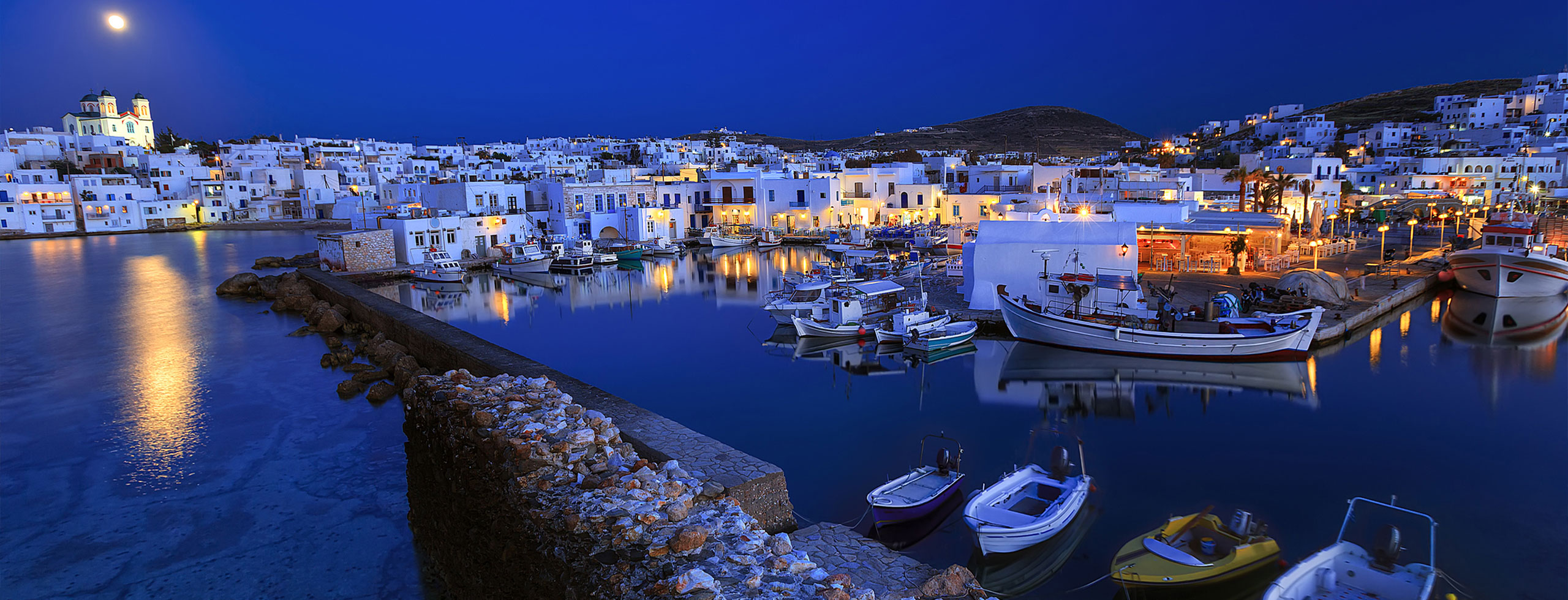
For many visitors of Paros, Naoussa is the main reason they fall in love with the island. You may very likely share that feeling, since Naoussa is indeed one of the most picturesque villages of the Cyclades. It’s a famous tourist destination and although it attracts many visitors every summer, it maintains the image of the small and pristine fishing village, with its picturesque harbor, the ruins of the Venetian castle of the 15th century – built by the Venetian governor of Paros Crucino Sommaripa – the colorful fishing boats, the yellow fishing nets, and the feeling of the times past perfectly blending in with the shops and more cosmopolitan atmosphere present today. When you walk around the main town, you will bump into many interesting post-Byzantine chapels – visit Agios Athanasios for an interesting collection of both Byzantine and post-Byzantine icons.
At Naoussa, in addition to all the facilities for a summer holiday, you will want to taste the wonderful mezedes (the various famous Greek dishes) at the various ouzeri and tavernas by the sea at the picturesque Naoussa harbor! After realizing how amazing Greek island food can be, you can wander off in the narrow streets of Naoussa or across the pier, where you will undoubtedly take a lot of pictures among the old fishing boats and the narrow alleyways with the whitewashed walls and the flower-decorated balconies. A stop at the Naoussa bars for a late night drink can top off a perfect evening!
But visitors also come to the area around Naoussa to enjoy some of the most beautiful beaches of the island. They are the well known Kolimbithres, a combination of few small beaches on strangely-shaped smooth rocks and with splendid turquoise waters – it’s quite a site. Limnes is a wide sandy beach close to Naoussa, while Agios Ioannis is a nice sandy beach that you will find if you follow the road north of Kolimbithres. Probably the best, but also most crowded, alternative further north from Kolimbithres is the sandy beach of Monastiri. The area around Kolimbithres also hosts the ruins of a Mycenaean acropolis, worth a small detour for exploration.
At the eastern part of Naoussa you can find some of the best if lesser-known beaches of Paros. You will first pass close to the beaches of Xifaras and Agioi Anargiri, but we recommend a stop at the exotic beaches of Santa Maria – a great choice – and Aliki. There are also many small beaches hidden among thickly grown cedars, where you can find your own quiet place to spend a few hours in isolation.
Route 3: A Tour around Paros
The main road to the south of Naoussa drives you through open fields of vineyards and areas filled with fruit trees and olive trees to the quiet beaches of Ambelas, Glyfada, and Tsoukalia. Before the village of Prodromos – according to tradition the birth place of Archilochos, one of the finest lyric poets of ancient Greece – you have the opportunity to explore the less-known face of Paros – and the less touristy one. So take the road that drives you to the amazingly beautiful village of Lefkes, built in the center of a fertile valley. Lefkes was the medieval capital of Paros and it has many historical monuments, like the superb Cathedral of Agia Triada. The picturesque village, miraculously emerging through the multiple pine trees, olive trees, almond trees, and eucalyptus trees around it, is home to houses built of neoclassical architecture. The entire village is worth a walk around the stone paved streets, the beautiful square, and its traditional churches. And of course you should not neglect to relax and cool off at the traditional kafeneia (“coffee places”), or dine on fine meat-based delicacies in one of the village’s tavernas.
Around Lefkes there are some interesting monasteries, such as Agios Ioannis Kaparos, beautiful locales, charming old chapels, and the picturesque village of Kostos, home of the famous teacher and writer of the late Turkish occupation Athanasios of Paros. About 10 miles (six kilometers) from Lefkes, at the small settlement of Marathi, you can explore the quarries from which the famous Parian marbles were cut. From Lefkes you can follow the road that takes you up to the top of the highest mountain of the island, Agioi Pandes, at 2,300 feet (771 meters), and enjoy the breathtaking view over Parikia and the northern coasts.
The northern coasts around Marpissa and Piso Livadi have some of the best and most cosmopolitan beaches of Paros: Logaras, Pounta, Mesada, and Tsardakia are full of people having a great time, while the famous Chrysi Akti gathers not only the sea and sun lovers but the experienced windsurfers from all over the world as well. After Dryos and to the north you can find the small, idyllic beaches of Lolandoni and Glifa. Aliki is a well organized summer resort and there’s a folklore museum close to the airport. From Aliki to Parikia, there are some small sandy beaches but it’s hard to find them through the dirt roads and the fields of Pounta. If you come here during the spring or summer you can pay a visit to the Valley of the Butterflies, on the road from Parikia to Aliki, where you will see thousands of butterflies that live here at this time. If you visit the valley, we are certain that you will be respectful of the natural environment and will keep your voice down so that you do not disturb the butterflies.
Route 4: Trip to Antiparos
In prehistoric times Antiparos was connected to Paros, but over time Antiparos was separated from Paros to become an autonomous island that didn’t follow the same path of development of its bigger and more famous neighbor. That’s why Antiparos has been for many years a more sophisticated destination for people who love the authenticity and the original beauty of the Aegean archipelago. Today you will find a lovely Cycladic village, with the ruins of a Venetian castle and with all the charm you will expect to find in an isolated setting of the Cyclades. This explains why Antiparos has been attracting crowds ranging from sophisticated Greeks to Hollywood movie stars. The award-winning Greek movie Madalena, with the magnificent music of Manos Hadjidakis, was also filmed in this village.
You can go to Antiparos by ferry boat from Punta beach (a ten minute ride) or by a smaller boat from Parikia (a half an hour ride). Don’t forget to bring your bathing suit because you will be tempted to swim at one of the many sandy beaches with amazing blue waters, such as Glifa, Plaka, or Akrotiri, as well as the isolated beaches of Livadi and Monastiri bay. Antiparos is worth a visit not only for the beauty of its main village and its beaches but also for visiting a real monument of the Cycladic nature: the impressive cave on Agios Ioannis hill. For that transfer as well as any transfer on Antiparos, you may use the local bus service. At the entrance of the cave you will see a huge stalagmite and in the cave you will be left speechless by the 120-feet high ceiling and the beautiful chambers, decorated with unique stalactite formations. In the chambers of the cave you will also see impressive carvings dated from the time of Alexander the Great until the time of the first King of modern Greece back in the early 19th century, Othon.
Museums and Activities
- Archaeological Museum, Parikia: Among the museum’s exhibits you will find unique masterpieces of Parian sculptures, such as the statues of Demeter and Gorgon the Medusa, and a section dedicated to the Parian Marble.
- Byzantine Museum, Parikia: Enjoy a fabulous collection of important icons and relics of the Panagia Ekatontapyliani, found in or donated to the church through the centuries.
 View Paros Map