



Rhodes Island Greece - Travel information, Rhodes hotels, villas, tours, restaurants, beaches, archaeological sites, nightlife
"The Island of the Sun" is one of the earliest and still favored destinations, offering visitors a wide spectrum of pleasure from fine beaches and fertile countryside, elegant restaurants and traditional tavernas, grand resorts and atmospheric hotels to shops with every possible kind of goods. There can be no denying that the main attraction of the island is the Old Town of Rhodes, the medieval quarter of the capital city, but from the village of the inherently beautiful traditional settlement of Lindos to the forest of the Valley of the Butterflies and the natural beauty of the southern part of the island, Rhodes presents an ideal environment for numerous pleasant days of discovery.
What more need be said about a destination known as both “The Island of the Sun” and “The Island of the Rose”? For that is the happy fate of Rhodes, Greece’s fourth largest island, that certainly lives up to the reputation evoked by these two images: an island of sunshine and flowers. It boasts of at least 300 days of sunshine annually supporting a comfortably warm climate tempered by the sea breezes; it also boasts of just enough rainfall between the fall and spring to maintain a varied and colorful vegetation. The result is an island that from ancient times has attracted humans, who have built everything from the spectacular classical Greek site of Lindos to the medieval town of Rhodes that is one of UNESCO’s elite World Heritage Sites. The climate in conjunction with this history has made Rhodes one of the world’s earliest and still favored travelers’ destinations, offering visitors a wide spectrum of pleasure–fine beaches and fertile countryside, elegant restaurants and traditional tavernas, grand resorts and atmospheric hotels, massive fortress walls and intimate houses of worship, specialized museums and shops with every possible kind of goods. Not to mention the site of one of the Seven Wonders of the World–the Colossus of Rhodes, albeit no longer in existence–Rhodes is truly an island for all seasons and all reasons!
Rhodes Geographical Description
Considering all that it holds, Rhodes is not that large–its area is about that of Oahu Island (in Hawaii) or the island of Lewis (the largest of the Hebrides). Most of the island is ringed with the fertile coastal plain; the interior is mountainous, with its highest point, Mt. Attavyros, standing high at 3,986 ft (1,215 meters). Geologically the island is part of the mountain range that comes down from the Peloponnesus mainland of Greece and arcs around to include Crete and then connects Rhodes to the Taurus Range of Turkey (only some 10 miles away).
Leisure on Rhodes
Rhodes today is a vibrant island, and one that combines a mix of archaeological and historical sites, natural and scenic attractions, and a wide selection of tourist facilities. Although most visitors to the island naturally concentrate on the city of Rhodes, there are numerous rewarding excursions to be made around the island. Undeniably, the principal destination of everyone who has come this far is to Lindos, one of the three original Dorian Greek cities on Rhodes. There are some remains to be seen at Ialyssos and Kamiros, but they cannot compete with Lindos, and many visitors will prefer to spend their time seeking out some of the other attractions of the island. If we had to recommend only one book that might inspire you during your visit to Rhodes, it would be Lawrence Durrell’s Reflections on a Marine Venus. Not a conventional guidebook, to be sure, but an imaginative work that captures the distinctive appeal of this island.
Rhodes Highlights:
- High Historical Value
- High Archaeological Value
- High Natural Beauty
Rhodes History
As the Eastern Mediterranean began to emerge in ancient times into an area of prosperity based on trade and colonization, Rhodes, situated at a crossroads between East and West, flourished to the extent that it was establishing colonies all around the Mediterranean Sea. By 490 BC, however, Rhodes was subjugated by the Persians and forced to fight against the Athenians in the Battle of Salamis (480 BC); when the Athenians defeated the Persians, Rhodes was effectively forced to become a tributary of Athens. Then, when Athens was in turn defeated by Sparta in 411, the three city-states formed a union and established a new capital at the northern tip of the island, the city of Rhodes, which greatly prospered in the ensuing centuries. The Acropolis of Lindos, one of the most photographed buildings of ancient Greece, and the Palace of the Grand Masters, built by the Knights of Saint John during the Crusades, are two of the most memorable historical sites of the island.
Rhodes Through the Centuries
Ancient Greeks would claim that Rhodes owed its existence and name to the nymph with whom either the sea-god Poseidon or the sun-god Helios had an affair with–as the Greek gods were known to do. In any case, the inhabitants of Rhodes probably adopted Helios as their patron deity because they prized the many days of sunshine that the island still enjoys. Some scant Neolithic (pre-2500 BC) remains have been found on Rhodes, but the first identifiable inhabitants seem to have been Minoans from Crete (by c. 1550 BC). The permanent settlement of the island began with the Dorian Greeks who moved down from northern Greece onto Rhodes after 1000 BC; before long they were dividing up much of the island into three city-states: Lindos, Kamiros, and Ialyssos. As the Eastern Mediterranean began to emerge into a new era of prosperity based on trade and colonization, Rhodes, situated at a crossroads, flourished to the extent that it was establishing colonies all around the Mediterranean. By 490 BC, however, Rhodes was subjugated by the Persians and forced to fight against the Athenians in the Battle of Salamis (480 BC); when the Athenians defeated the Persians, Rhodes was effectively forced to become a tributary of Athens. Then, when Athens was defeated by Sparta in 411 BC, the three city-states of Rhodes felt strong enough to resist Athens by forming a sort of union and establishing a new capital at the northern tip of the island.
This was the city of Rhodes, and although it greatly prospered in the ensuing centuries, its fine harbor and new fortifications made it a prized target for whichever power dominated the eastern Mediterranean–the Spartans, the Athenians, the Carians of Turkey, the Macedonians of Philip II, and then the forces of his son, Alexander the Great. When Alexander died in 323 BC and his empire was divided up, Rhodes aligned itself with the Ptolemies, based in Alexandria. This led to one of the most famous sieges in all history: Between 305-304 BC Demetrius of Macedonia attacked the city with 400 ships, 40,000 troops, and some of the largest siege machinery known to that time. Failing to take the city, he signed a peace treaty and left behind his siege machinery. Allegedly the Rhodians sold it to raise the money for the bronze used in making the 100-foot high statue of the sun-god Helios. Exactly where in the harbor this stood is debated (it almost certainly did not “bestride” the harbor) but the statue became known as the Colossus of Rhodes–one of the Seven Wonders of the Ancient World! Erected c. 290 BC, it stood until 225 BC when a terrible earthquake toppled it. The bronze fragments lay there for some eight centuries until in AD 653 pirates carried them off to Tyre, the Phoenician port in Lebanon, where they were sold and eventually melted down.
Meanwhile, Rhodes continued to flourish as a great commercial center; its ships and crews were greatly admired, its currency was accepted everywhere, and its commercial-maritime law was highly respected and was later adopted for the Roman Empire by Augustus. By the second century BC, Rhodes had aligned itself with Rome, and although Rome was clearly the senior partner in terms of power, Rhodes was looked up to for its mature culture. It boasted of a school of rhetoric (what we today might call “public speaking”) that was attended by many notable Romans–including Julius Caesar, Cicero, Cato, and Lucretius. Rhodes was also famous as the center of sculptors; probably the best known work to come out of Rhodes was the Laocoön, which was excavated in 1506 in Rome and is now to be seen in the Vatican Museum. Rhodes also attracted painters, scientists, and literary artists. Then Rhodes made the mistake of siding with Julius Caesar, so that after his assassination in 44 BC, Cassius attacked and plundered Rhodes, effectively destroying its fleet. Rhodes never really recovered from this and by AD 79 it was incorporated into the Roman Empire.
For the next 1,200 years Rhodes was subject to a series of foreign rulers and earthquakes that demoted the island to the backstage of history. However, Christianity took root here, supposedly following a visit of Paul the Apostle in AD 57 (legend has it that he put in at Lindos although the Bible never actually states that he landed). The Christian community grew to the extent that there was soon a Bishop of Rhodes who became the chief prelate of this part of the Mediterranean. But Rhodes did not emerge into the front ranks of history again until AD 1306, when the Knights of St. John of Jerusalem (also known as Knights Hospitallers) purchased a part of Rhodes from the Genoese who had taken it after the Fourth Crusade. These Knights were mainly the lesser aristocracy, soldiers, and adventurers from Western Europe who had been drawn to the “Holy Land” to take back Jerusalem and other Christian sites from the Muslims. In 1291 they had retreated to Cyprus and now they decided to move on to Rhodes, and by 1310 they had effectively taken over the city and the whole island.
There is no denying that the city of Rhodes and the economy of the island as a whole generally prospered under the rule of these rich and powerful men. But the Knights never could defeat the Muslims, who placed Rhodes under three sieges, the last of them commencing in 1522 and, just like the siege of 305-304 BC, has been recorded as one of the greatest sieges in history. Its final stage was personally led by Suleiman I (“The Magnificent”), the leader of the Ottoman Turks. Blockading the island with hundreds of ships and allegedly with as many as 100,000 troops, Suleiman attacked the fortified city of Rhodes, defended by only about 650 Knights, another 650 allies, and at least some of the 6,000 residents. At the very end of December, after holding out for some six months, the Knights capitulated, and on January 1, 1523, led by their Grand Master, Villiers de l’Isle-Adam, the surviving 180 Knights moved to Crete, finally settling in Malta in 1530.
For almost four centuries, Rhodes languished under Ottoman Turkish rule–an occupation marked more by neglect than of harshness. Its churches were converted into mosques but in 1660 priests were allowed to return to administer the Christian rite (at first to the slaves!). By the early 20th century, the Ottoman Empire was crumbling and in 1912 Italy declared war against it and took over Rhodes along with a number of other islands known as the Dodecanese. “The Twelve Islands” in Greek, a name only coined in 1908, did not originally include Rhodes; today there are in fact 14 major islands in the Dodecanese Prefecture. As a result of Italy’s participation in World War I, Rhodes and the other Dodecanese were awarded to the Italians, who under Mussolini ran a relatively benign occupation and erected a number of quite impressive buildings. In World War II, British and some other Allied forces invaded Rhodes in 1944 and in 1945 liberated it from the Germans (who had taken over from the Italians). Officially it was March 7, 1948 that Rhodes–after some 2,000 years of foreign occupation or meddling in its life–was formally united with Greece, whose language and culture had never been abandoned by the majority of the inhabitants of Rhodes.
In ancient times, when the island’s sailors and merchants ruled the southeastern Mediterranean, Rhodes was one of the most powerful and rich towns of Greece. In order to get a sense of this ancient history, you have to walk up the hill called Monte Smith, where among the green fields, the wild flowers, and the pine trees you will find the ruins of the ancient Acropolis of Rhodes. The ruins belong to the Hellenistic period (3rd century BC), and among other remains include the temples of Zeus Polieus, Athena Polias, and Pithios Apollo, as well a stadium and an Odeon for 800 spectators.
But there can be no denying that the main attraction of the island is the Old Town of Rhodes, the medieval quarter of the capital city. There is so much to see that it is hard to know where to start–or stop–but the walls are the obvious boundary. Built by the Knights of St. John (using locals, captives, and slave labor), the original foundations were of an earlier period but the great walls we see today–with their gates, towers, bastions, and ditches–are largely the result of work done in the late 15th and early 16th centuries. The walls of Rhodes are a Hollywood vision of a medieval fortress: their total perimeter is some two miles, and much of this can be walked on a combination of the upper and lower courses.
However long one explores the walls and whichever gates one enters through, most people will head straight for the Street of the Knights, carefully restored with cobblestones and authentic architectural details. It is generally regarded as the best preserved medieval street of all Europe. Along both sides are the “inns” of the knights–more like their headquarters and guest houses–designated by names such as Tongue of France or Tongue of Italy, reflecting the fact that the Knights of St. John came from various countries throughout Europe and spoke different languages. At the far end of the street is the monumental and majestic Palace of the Grand Master, with its imposing entrance and massive towers. The interior has many priceless treasures, and a visit to the Palace may be one of the most rewarding activities of your stay in Rhodes. It must be admitted that what we see today is essentially the 1930s reconstruction of Italians (what has been called “Mussolini manorial”), but it is worth visiting as a museum, and even if not historically authentic as architecture, this palace does convey a sense of the power that the Knights exercised over this island for over 200 years.
The part of the city where the Grand Masters and the Knights lived, grouped by country of origin and language, is called Kollakio, while the common people–the Greeks and the Jews–lived in the Bourg an area filled with churches, synagogues, and public buildings. Just wandering through the narrow medieval streets of old Rhodes yields constant delights–archways, courtyards, gardens, or hammams (Turkish baths) –all blending together to create a unique, picturesque, and enchanting town.
Then there is the Rhodes that is the direct descendent of what made Rhodes so prominent and prosperous from ancient times to the present: A bustling emporium of products both domestic and imported. The main “bazaar” in the old town is on Sokratous Street but numerous side streets branch off from it. In the shops that line these streets you can purchase everything from expensive clothing and jewelry to moderately priced textiles and ceramics to cheap beach gear and souvenirs.
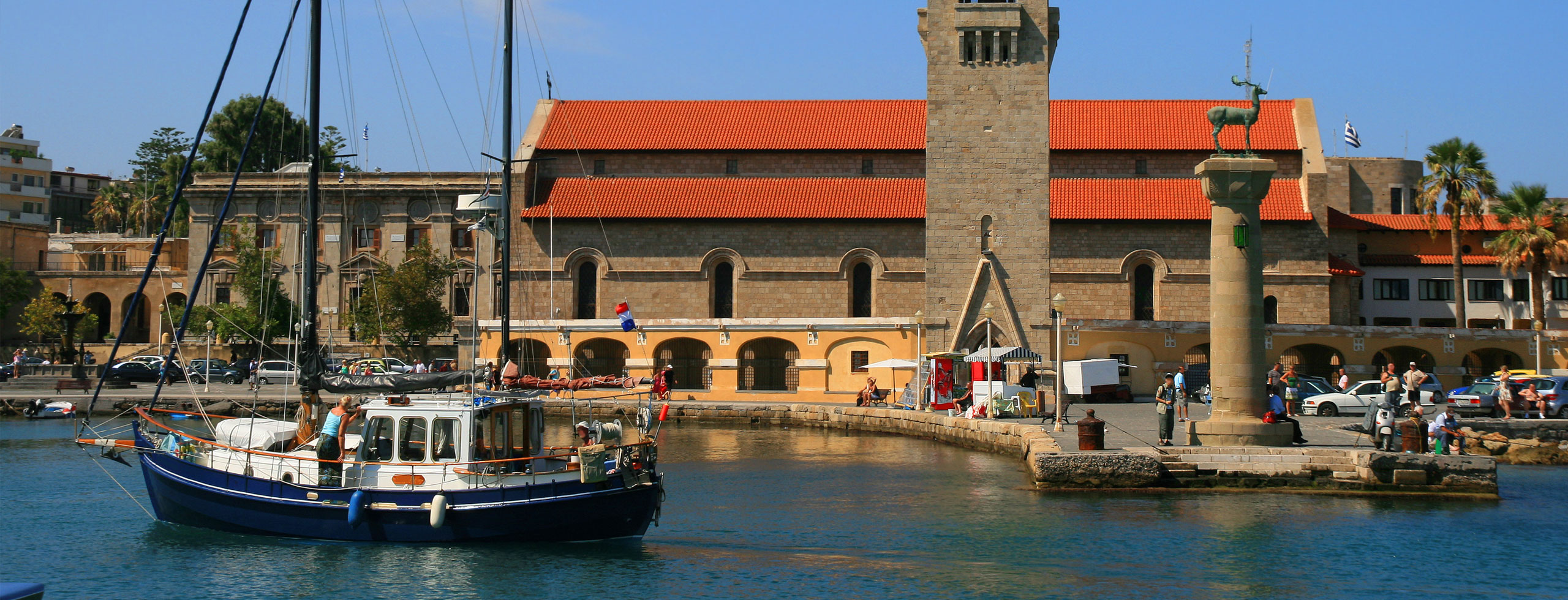
Outside the walls lies the New Town, facing the Mandraki Harbor, guarded by two bronze deer and the three windmills. Presumably once the site of the Colossus of Rhodes, it is now crowded with yachts and inter-island ferries. The Italians who ruled the island in later years left a very clear mark on the architecture of this part of Rhodes. Walking along the waterfront, you will see some remarkable buildings with soft curves and pastel colors, built according to the colonial Italian style. Such buildings are the National Bank, the Court House, the National Theatre, the Post Office, and the fine Aquarium, worth a visit to see many species of the Greek Archipelago swimming in their crystal tanks.
Route 2: From Rhodes town to Lindos
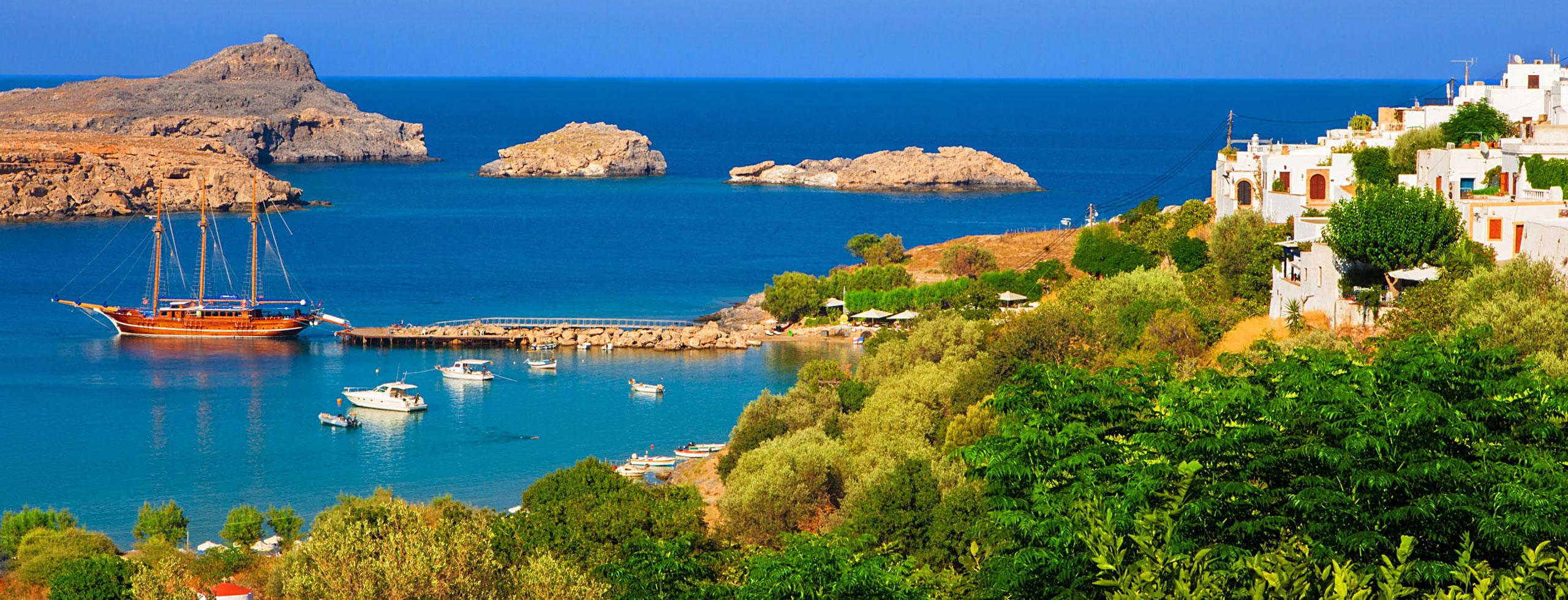
Lindos village is one of the most beautiful and picturesque villages of the Aegean as well as the location of the island’s most significant archaeological site. The route from the city of Rhodes to Lindos takes you along some of the most famous beaches of the island. The first one you come to is the world-famous Faliraki beach, below the village Kalythies: It is a long sandy beach, well-protected from the northern strong summer winds. Afandou beach is the next highlight of the route, and further along the way you will find Tsambika and the beaches below the village of Archangellos–the latter can generally be described as smaller, more picturesque, and quieter beaches. After Archangellos the road runs through flat landscape until Kalathos village, and the long turn-off road takes you to a sandy beach that stretches for miles around the Reni bay. On the northern edge of the bay lies the little-known castle of Feraklos, while on the southern edge of the bay lies another much more famous village, Lindos, which you reach by turning left off the main road.
The Lindos Acropolis sits high above the village and some people may want to take advantage of the donkeys to make the ascent, but a slow steady walk up the long ramp-like stairway brings you to the lower entrance (don’t fail to look closely at the carved ship’s stern on the rock face to the left; it dates from c. 180 BC). Now comes a steep stairway up to the lower level of the acropolis with the remains of various structures; then, climbing up the broad ancient steps, you come to the upper level and head for the columns of the Temple of Athena (c. 350 BC), one of the most photographed buildings of ancient Greece. Part of its impact depends on its location: it is isolated at the edge of a steep cliff (from which, by the way, you can look down to the small rock-bound harbor where legend claims Paul the Apostle landed). It is a truly spectacular experience to stand here and gaze down to the sea.
On descending, you will want to take at least a short time to appreciate the village of Lindos, designated a national landmark to preserve its traditional narrow streets, architectural details, homes, and other buildings. At the very least, step into the Church of the Panagia with its remarkable 17th century frescoes.
Route 3: From Rhodes town to Ialyssos and Kamiros
An excursion to Ialyssos and Kamiros offers not just archaeological sites but perhaps more important for many people, numerous attractions along the way. The coast from the city of Rhodes to Trianda (also called Ialyssos) passes by the island’s major hotel-resorts, providing hundreds of rooms overlooking the sandy beach of Ixia. When you arrive at Trianda, don’t be fooled by the village’s modern look: by taking a small turn from your route to go up the pine-covered hill of Filerimos you can enjoy the ruins of the famous ancient town of Ialyssos. At this site you will find ruins from various historical periods, ranging from ancient times to the Byzantine period and the times of the Knights.
Moving on from Trianda you will pass by green fields, villas, hotels, restaurants–and the island’s airport. When you reach Theologos village you ought to pay a visit to one of the island’s most popular attractions: The Valley of the Butterflies. In fact, they are moths, many thousands of them drawn (especially in July and August) by the scent of the storax, the resin from the sweet gum tree that grows here–Roman Catholics use it to make incense and also use the seeds of its fruit to make rosaries! In any case, innumerable insects cover the bushes and the tree trunks around the idyllic green valley, at times flying in a colorful and impressive cloud. If you do visit the valley, you are requested to respect the natural environment and keep your voice down so that you do not give flight to the butterflies.
Moving to the main road to the south you will easily find the important archaeological site of Kamiros, a site full of ruins of ancient temples, fountains, and markets. At prehistoric times people here worshiped the ancient gods that taught the humans how to make bread! Moving along, there are some nice and quiet beaches until you reach the little harbor village of Skala Kamirou, from where the boats to nearby Halki island depart. On the top of the hill there is a nice Venetian castle offering a perfect location to enjoy the sunset!
Route 4: Central and Southern Rhodes
One of the least visited but most beautiful regions of the island is hidden in the mountain villages of central Rhodes, around Mt. Attavyros, the highest mountain of Rhodes. Villages like Embonas, Kritinia, Siana, Agios Isidoros, Arnitha, Laerma, Monolithos and more have kept the native flavor of the countryside of Rhodes: here you will find old castles, churches, beautiful old houses, and of course some little-known small traditional tavernas. Many dense pine forests full of streams surround the mountains and the villages of central Rhodes create an enjoyable and less-known landscape of Rhodes.
For those willing to explore even further south, you can head southwest from Laerma, picking up the main coast road below Lindos and continuing on southward. This road then passes by the long and less developed sandy beaches of Lardos, Kiotari, and Genadi and eventually reaches the small quiet village of Kattavia, built into green fields full of vegetables. From Kattavia you can take the road that leads to Prasonisi, the southernmost part of Rhodes Island. For many people Prasonisi is the best beach of Rhodes. Certainly, the exotic landscape with the shallow sandy waters that let you walk to the small Prasonisi Island provide for a wonderful and picturesque setting. The strong winds that usually blow in the summer make those beaches very attractive to windsurfers.
Route 5: A Day-Trip to Symi
Those with more time on Rhodes might well consider a day-trip to Symi, less than 10 miles north of Rhodes and in recent years a major attraction. There are boat connections with Rhodes throughout the year, most frequently during high season. Symi was once a prosperous center of shipbuilding, merchant shipping, and sponge-diving, but after World War II these failed to revive and the island was all but deserted.
This, however, has contributed to its present charm, for the old mansions and villages survived unchanged; as a result, Greeks and foreigners now flock here to savor the traditional feel of the island. An increasing number of expatriates have returned to the island, and today there is some shipbuilding, an emerging tourism industry, and even a bit of sponge-fishing. Yialos, the main port, is where the action is, such as it is, but most visitors will want to take the bus or taxi up to Horio, the old capital with its Church of the Panagia. Another favorite destination is the Panormitis Monastery, now virtually a guest house. Those more interested in a swim have their choice of several beaches–Pedi, St. Nikolas, or St. Marina.
Museums & Activities
- The Palace of the Grand Masters, Old Town of Rhodes. In addition to taking in the impressive medieval castle architecture, visitors are able to enjoy several exhibits with artifacts and information that spans the island’s extensive history.
- The Archaeological Museum, Old Town of Rhodes. Housed in the former Hospital of the Knights, this museum features ancient Rhodes ruins such as pottery and sculptures, mainly found in the Kamiros excavation.
- The Byzantine Museum, Old Town of Rhodes. Located in the Church of the Panagia, this museum hosts religious icons and frescoes from the Byzantine era.
- Museum of Decorative Arts and Folklore, Old Town of Rhodes. Gain a cultural perspective through observing traditional costumes, fabrics, or pottery –all representing important aspects of everyday life in Rhodes through the centuries.
- Municipal Gallery, City of Rhodes. This impressive modern building houses works by Greek artists of the 19th and 20th century.
- Shalom Synagogue, Old Town of Rhodes. A reminder of the once flourishing Jewish community in Rhodes, the Synagogue also maintains a small museum that presents relevant photographs, books, manuscripts, and clothing.
 View Rhodes Map