



Naxos Island Greece - Travel information, Naxos hotels, villas, tours, restaurants, beaches, archaeological sites, nightlife
Long before the movies, advertisements and tourists discovered Mykonos and Santorini, another of the Cycladic Islands was famed in song and story and had drawn many foreigners to its shores. That island is Naxos, one of the Cyclades, the group of islands that encircle Delos (cyclos being the Greek for “circle”), birthplace of Apollo and Artemis and a pilgrimage shrine for ancient Greeks. And now today, Naxos is re-emerging as an increasingly more popular destination for visitors, drawn there by its lush vegetation, lovely beaches, leisurely nightlife, lofty structures, and lively history. Naxos tends to inspire such effusions by everyone from Herodotus to Byron, and we are confident a visit will confirm them. Here we can only explain and justify what lies behind them.
Naxos is the largest of the Cycladic islands and although it may not have the historical dazzle of other Aegean islands, it is highly regarded in Greek Mythology. It is said that even though Zeus (the father of the Gods of Olympus) was born in Crete, he grew up on the island of Naxos, giving his name to the mountain on which he resided. The Mountain of Zas or Zefs as it is pronounced in Greek stands tall above the island, reminding visitors of the splendours and diversity of this multifaceted island. But the better known myth is that involving Theseus and Ariadne. In this one, you may recall, Theseus had slain the Minotaur in the labyrinth on Crete and had escaped from it thanks to the Minoan princess Ariadne. Theseus then took Ariadne with him as he fled Crete but when they landed on Naxos and she fell asleep on the shore, he abandoned her and went on to Athens. Ariadne got revenge of a sort, however, when the god Dionysus found her and married her. This tale inspired many poets and provided the plot for one of the finest 20th century operas, Richard Strauss’s Ariadne auf Naxos.
Naxos Geographical Description
At 169 sq miles (438 sq km)—approximately the size of the Hawaiian island of Molokai or the Caribbean island state of Antigua and Barbuda—Naxos is the largest of the Cyclades. Possibly because of that size, it has an interior with mountain slopes and valleys protected and fertile enough to support more greenery and trees than any of the other Cycladic islands. Mt. Zefs, or Zas, at 1,004 meters (3,294 feet) is also the highest peak in the Cyclades. In addition to the ubiquitous olive trees of Greece, there are fig and orange and lemon and pomegranate trees. Naxians also pride themselves on their honey and wine, and in the ancient world, their marble was much prized by sculptors. But what Naxos really can boast about is how much myth and history have been centered on this relatively small island.
Leisure on Naxos
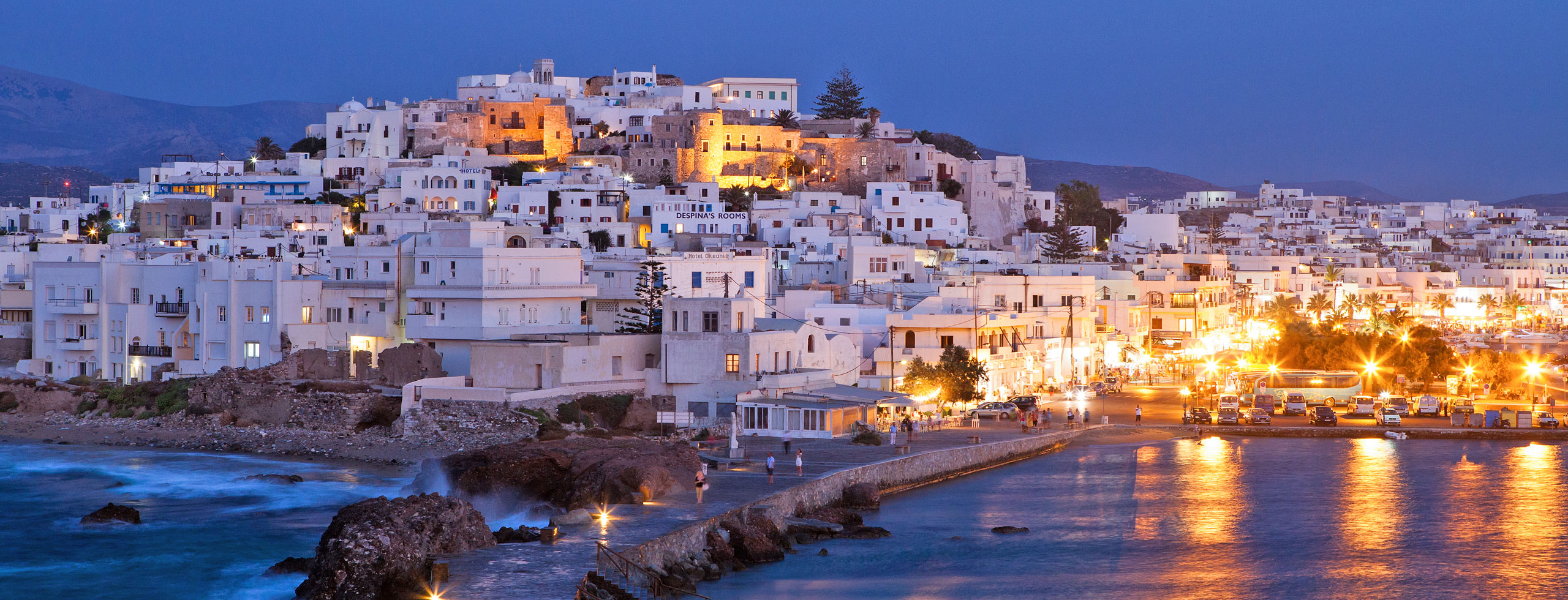
Hora (sometimes referred to as “Naxos Town”) has many attractions to please the visitor looking just to relax. There is now a wide selection of restaurants and cafes, many situated to offer fine views of the harbor and sea. There is a lively music scene, offering everything from nightclub rock to classical music, jazz, and Greek folk music. There are also some popular beaches not far from the town—the finest being the Plaka Beach. But just wandering the old streets of the town gives you the sense that you are in a truly “lived in” place, so that Hora becomes both a place to enjoy on its own and a base for making excursions around the island.
Naxos Highlights:
- Great Beaches and Mountainous Villages
- Picturesque Scenery
- Extraordinarily Authentic & Intimate
Naxos History
Although Naxos was never a pivotal island in the formulation of Ancient Greek or Modern Greek history, it was always regarded as a “must have island” by the current ruling state, ambitious invader, or successful conqueror. Constantly changing hands throughout its long history, Naxos can claim to have one of the most multicultural backgrounds in the Aegean as at some stage it has been ruled by the Ancient State of Athens, Byzantine Empire, Roman Empire, Ottoman Empire, Venetians, Russians, Turks, Italians and finally Greece. There are several museums exhibiting works from the different phases of Naxos’s past. But perhaps the most eye-catching feature of Hora is the Portara, or Great Door, a portal that is all that remains of a 6th century BC Temple of Apollo. Situated on the islet of Palatia on the edge of the harbor, it greets all visitors as they sail into its harbor and has become for Naxos what the Statue of Liberty is to New York or the Eiffel Tower is to Paris.
Naxos Through the Centuries
As for its history, Naxos was settled at least by the early 3rd century, and between 2500-2000 BC its inhabitants were among those making the fascinating marble idols known as Cycladic figurines. You will have seen these figurines pictured and reproduced even if you have not seen an original in a museum, and once seen they are never forgotten, for their smooth white marble and completely abstract-stylized rendering of the human form makes them seem as modern as anything done today.
The Cycladic culture that produced these remains something of a mystery but the next phase of history on Naxos is the well-known Mycenaean Age (c. 1500-1100); some remains of this culture can be seen. The island remained continuously inhabited from that time on although Herodotus claimed that some centuries later it was resettled by Athenians. Having been attacked by the Persians in 490 BC, the Naxians sent a fleet to join the Athenians that defeated the Persians in the naval battle at Salamis (480 BC) but their reward was effectively to be taken over by the more powerful Athenians by 470 BC. From that point on, the fate of ancient Naxos was tied to that of Athens, eventually falling under the rule of Alexander the Great’s successors and then under the Romans. With the decline of Rome’s authority in the eastern Mediterranean and the rise of the Byzantine Empire, Naxos was left alone to cope with the pirates who roamed the Aegean. As a result many Naxians left the coastal towns and settled inland. However, Naxos remained a major way station for ships plying the Aegean and even became the seat of a Christian bishop.
The great change in Naxos’s fortunes came in 1207, when Western Europeans leading the Fourth Crusade got sidetracked and took over Constantinople from the Byzantine Greeks and proceeded to divide up the Byzantine Empire. One Marco Sanudo, a well-placed Venetian, decided he wanted his share so he embarked for Naxos with a band of supporters and soon conquered the island. He then decided to place himself under the authority of Henry of Flanders, who by then was the Roman Catholic ruler based in Constantinople, and in return Henry made him a Duke. Various families retained rule of Naxos for almost 200 years but in fact they and the island were really under the control of Venice.
In 1566, Naxos fell to the Ottoman Turks, who were gradually taking over the Byzantine Empire throughout the eastern Mediterranean. More interested in reaping the profits in the form of taxes and duties from such properties, the Ottomans appointed bankers to oversee “investments” such as the island of Naxos.
Taken in by the new Greek nation in 1832 Naxos’s fortunes now followed those of Greece—decades of struggling to establish a true democracy and improve its economy. During World War II Naxos was occupied mainly by Italians and the inhabitants, although not abused, suffered considerably from lack of proper food and general isolation. With the end of the war, Naxos continued to follow in the wake of the mainland, and it was not until the 1970s that Greece began to experience true prosperity, much of it due to tourism. Naxos had many of the natural features to attract tourists but at first it lacked the infrastructure—hotels, restaurants, roads—and other islands took the lead. But in more recent years, Naxos has, as they say, “caught on,” and it now offers the complete menu of amenities.
Naxos is today home to many remains from the centuries of Venetian rule, starting with the great Castro that dominates the main city of Naxos, known simply as Hora (“the Town”). Equally impressive is the Roman Catholic Cathedral in the Castro precincts; its marble façade is the first thing that strikes visitors, but within it is the altarpiece ikon (painting) of the Virgin dating to at least the 13th century (and possibly as old as the 10th). There is still a sizeable Roman Catholic presence on Naxos consisting of some descendants of the original Venetians but now Greek in all other ways. Then there is the Orthodox Mitropolis Cathedral, while adjacent to it is the site of excavations that preserve remains of continuous occupation of the site back to the Mycenaean time.
ROUTE 1: Naxos town and the southwestern coast
Upon arrival at Naxos harbor you will be greeted by a string of new, modern buildings along the waterfront that at first sight may seem quite uncharacteristic of a Cycladic island.
If you were looking for a more authentic and classical Cycladic Island do not despair the real treasures are hidden in the back streets. The beautiful medieval town and the traditional old houses will become clearly apparent once you start walking through the narrow streets.
Meander through the slender streets until you reach the Venetian fortifications where you will enter the charming world of the Naxos town castle (or the Castro). The medieval streets have been kept intact within the Castro and if you follow them you will reach the center of this small medieval town where you will see the ruins of the Marco Sanudo tower. Surrounding the little square you will find the most interesting buildings: the archaeological museum, hosted at the old Jesuits commercial school, the cathedral of the Catholics, the Sanudo’s chapel known as the Capella Cazatza, the Saint Antoine of Padova chapel, the Ursulines monastery, the Crispi palace which hosts an impressive Byzantine collection, and the old mansion of the Barozzi-Delarocca family, which is also the Venetian Museum. Walking around the whitewashed houses and the narrow streets you will discover the old market with its quaint shops (jewelry, artisans, small galleries and picturesque tavernas). Passing through the streets of the old Borgo you will reach the harbor at the Metropolis where there are some post Byzantine churches and very interesting archaeological sites, with the ancient burial Tomb of Grotta being one of the highlights.
Only a stones throw away you will find the famous Portara, one of the most photographed sites on Naxos due to its amazing location and awe inspiring view of the sunset. The Portara ruins (meaning huge door!) are the remnants of a 6th century B.C. temple dedicated to Apollo, which lay on a small cliff beside the harbor, on a small peninsula called Palatia. From Portara you will enjoy the beautiful sunset and take some breathtaking photos. Some go as far as calling the Portara sunset the “best sunset in the Aegean".
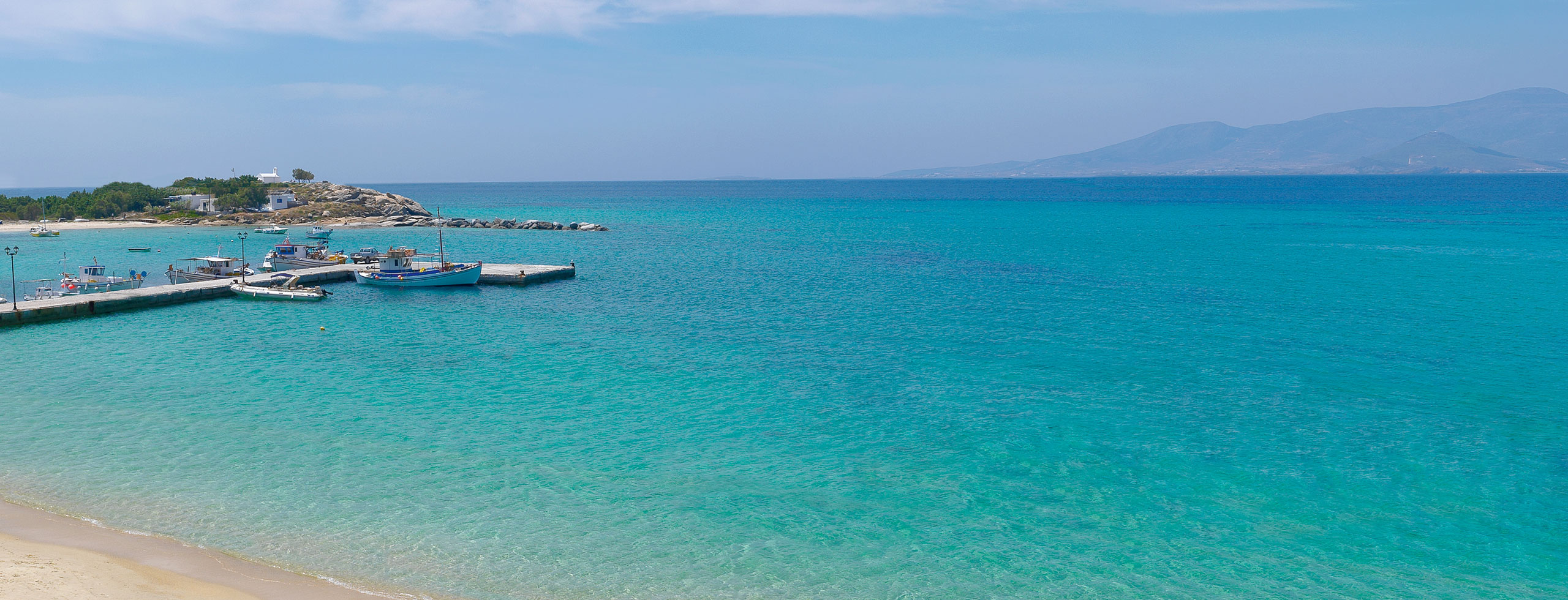
On the south west coast of Naxos you will find the best and most popular beaches of the island, about 40 kilometers of clear sand and shallow, turquoise waters. Starting from Agios Georgios near Naxos town (famous beach for windsurfers), you will reach Agios Prokopis, Agia Anna, Marangas and Orkos. Near Pirgaki beach you will find a unique cedar forest with a small idyllic beach hidden under the towering trees. If you are feeling adventurous and are fond of kite surfing, Mikri Vigla is the beach for you, while if you are looking for something more isolated and romantic you might try Alikos, Glyfada and Agiassos.
Following the coastal road toward the southwest you will find some extremely beautiful and authentic villages such as Agios Arsenios, Vivlos, and Sangri, a beautiful small medieval settlement with Byzantine churches. Located approximately 4 kilometers from Sangri is the very impressive archaeological site of Gyroulas, with the impressive marble temple of Demeter. Don’t forget to visit the small but very interesting museum beside the archaeological site.
Only a short distance from Sangri you will also find one of the best preserved Venetian buildings; the Bazeos tower – once a Christian orthodox monastery dedicated to the Holy Cross, this complex has earned an architectural restoration award and during summer months hosts various modern cultural events such as exhibitions, concerts, or theater plays.
If you are still looking to enrich your knowledge of archeology you shouldn’t miss the temple of Dionysus at Yria (an area very close to the airport).
ROUTE 2: The main road to the north
Since Naxos is the biggest island in the Cyclades, the distances you will have to cover will be quite large, not to mention that due to the mountainous landscape you will have to “navigate” the narrow “snake-like” roads. For this reason you should give yourself plenty of time in order to drive through the island as you cannot drive fast!
The main road to the north will take you over the rocky northwestern coast and straight to the Eggares village. Just a short distance from the village is the Ypsilis Tower, an impressive stone made complex (tower and monastery) than dates to the 17th century.
Following the road around the mountain slopes you will enjoy the spectacular views over the Aegean and if the weather is clear you may see the neighboring island of Paros. Once you arrive at the village of Apollonia you have reached the northernmost part of the island, where you will find secluded and remote beaches such as Amitis, Abram, Agios Mamas, as well as some lovely taverns where you can enjoy fresh fish. However keep in mind that due to the strong northern summer winds, the famous ”meltemia”, most of these beaches will be subject to large waves.
A couple of kilometers before the village of Apollonia you will see one the three ancient Kouros of Naxos, a semi finished colossal statue of a man or ancient Greek god abandoned at the ancient quarry from the 7th-6th century B.C.
From Apollonia you continue to Komiaki, a beautiful mountain village with famous local musicians, and Koronos, a big village with a spectacular view of the lush green valley below. The people here used to work at the smirigli (emery) quarries that are spread all over the Amomaxi mountain. As you reach the nice beach of Lionas (approximately 7 kilometers from Koronos), you will see all the old caves and digging sites.
ROUTE 3: Apeiranthos and the east coast
For many of the visitors coming to Naxos, Apeiranthos is the most beautiful village of the island. It is located on the mountain with spectacular views of the sea and the “small Cyclades” islands of Koufonissia, Amorgos, Donousa, and Keros. Lovingly called the “Marble Village” by locals and surrounded by lush green valleys and rocky cliffs, the architecture of this unique village has been meticulously preserved and is characterized by its neoclassical mansions, white churches, beautiful squares, and lovely streets and stairways, all made of white marble.
The local population of Apeiranthos has preserved old habits and traditions and an interesting folk culture. The most fascinating of these traditions is the local language, which is similar to the language spoken throughout some mountain villages in Crete! There are five small but interesting museums in the village which are worth a visit: the archaeological museum, the folk museum, the natural museum, the geological museum, and the gallery of local artists.
From Apeiranthos you may follow a beautiful route to the small coastal village of Moutsouna, where there is a small harbor for the ships that used to carry the smirigli (emery). From Moutsouna to Panormos the road is quiet and pleasant, running besides small isolated beaches such as Psili Ammos, Liaridia, and Kleidos, while the sandy beach of Panormos is located at the end of the road. If you want to get back to Naxos town you will drive from Apeiranthos through the mountains, where you will pass through the small but picturesque villages of Keramoti and Kinidaros.
Along this road you will also find the archaeological site at Melanes, close to Mili village, where you will see the ruins of several ancient temples and settlements and an ancient aqueduct hidden in the green valley. Only a short walk away you will find the second semi-finished archaic Kouros of Naxos, the Kouros of Melanes.
Continuing on the main road you will reach the village of Kourounohori, where standing tall you will see the Delarocca tower. Once you leave the village of Kourounohori the houses of Naxos town will become visible in the distance.
ROUTE 4: Filoti and the Tragea plateau
Having a population of about 1800 people, Filoti is one the biggest villages in the Cyclades and includes a quaint old neighborhood where you will see the old venetian tower of Barozzi. Over Filoti you will see the superb view of the Zas mountain (the name means Zeus, the ancient Greek god) and from the fountain of Aries, approximately 2 kilometers south of Filoti, you will find the path that leads to the superb Zas cave at the top of the mountain, the tallest peak in the Cyclades islands standing at 1,004 meters, or 3,294 feet, in height. There is a spectacular route from Filoti to the Kalandos beach that takes you through a magnificent landscape where you will see the ancient tower of Himarios, dating from the Hellenistic period (2nd century BC). At Kalandos you will find a sandy beach and a brand new, well- equipped marina.
The entire area south of Filoti and especially around the village of Halki (including a dozen other villages such as Kaloxylos, Damarionas, Damalas, Acadimi, and others) is called Tragea and during the Byzantine era was one of the most important places in the Aegean. In addition, there is a unique group of Byzantine and early Byzantine churches in the vicinity of Tragea. Most of these historical monuments are quite spectacular and host fantastic frescoes and wall paintings. Since you can only visit some of these monuments, don’t neglect to see Panagia Drosiani, Agios Georgios Diasoritis, Panagia Damiotissa, and Agii Apostoli Metohiou.
Moving on to Halki you will find the financial and commercial center of the Naxos mainland during times past. Halki, filled with neoclassical buildings and Venetian towers, still maintains a very nice atmosphere of the ages of glory. You will find little but very elegant shopping here, while a site you should not miss is the old citrus liquor factory of the Vallindra family. There you will learn that the Naxos citrus is a tasty, digestive liquor that is made from the leaves of the citrus trees: once there were thousands of them around Halki. This traditional alcoholic drink is still being made here by the very same family and at the same old distillery using the same traditional methods!
From Halki you can follow the road to the three Potamia villages (Mesi, Ano, Kato Potamia), passing under the steep cliff on top of which you will see the ruins of the Apano Castro (which is a 30 minute trek from Tsikalario village), the most daunting Venetian castle on the island. From Potamia, Naxos town is only a short drive away.
 View Naxos Map